Orion and the Zodiacal Light
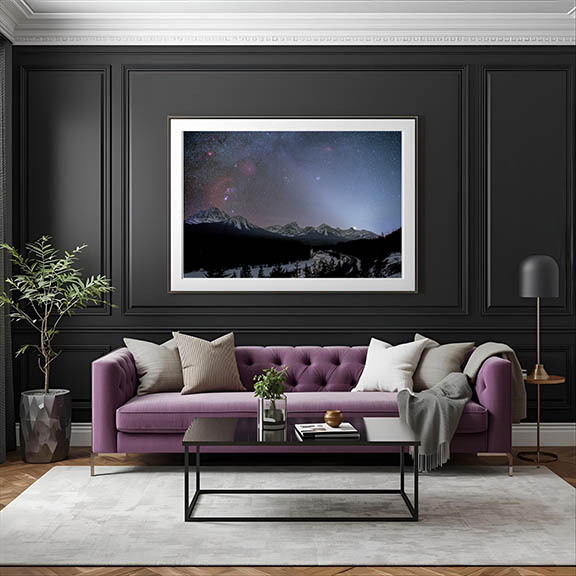
All fine art images are available to purchase as archival limited edition prints, produced on 13×19 inch giclee fine art paper and can be delivered unmatted or matted with acid free archival matting and backing board to 18×24 inches. Contact me directly for more information.
Orion and The Zodaical Light - This is a limited edition of 8
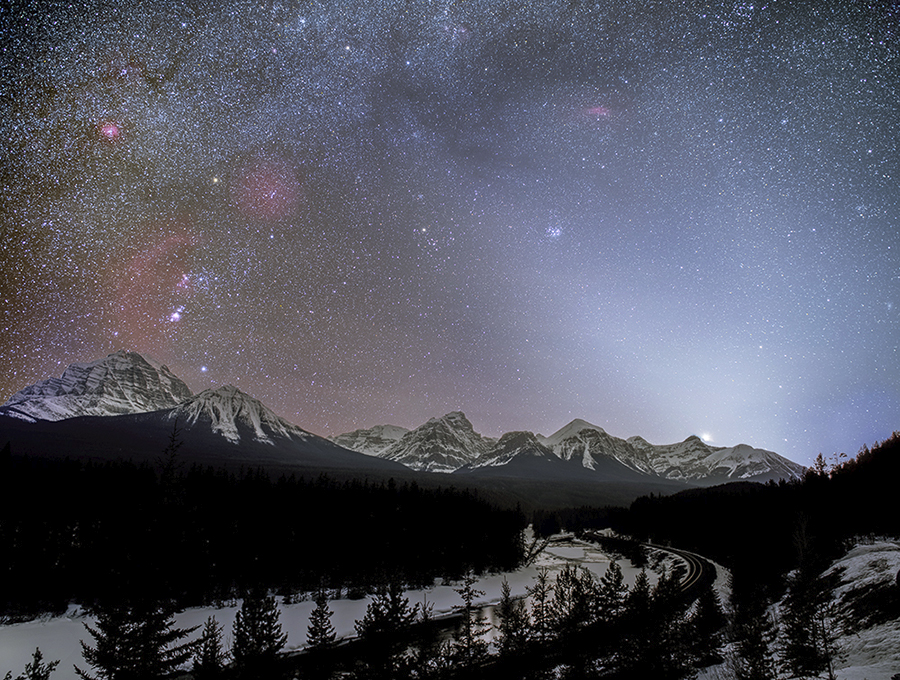
The Great Orion Nebula, Venus and the Zodiacal light are all visible in this image shot on March 22 2023, during a long fridgid photoshoot on the side of a Rocky Mountain.
Morant’s curve is an iconic location in the Canadian Rocky Mountains where people come to photograph the trains tracelling along the valley of the Bow River. My friends and I actually saw four trains pass by during the 8 hours we spent on the mountain, but that is a story for another image….
Turns out it is a lovely albeit cold place to watch the winter constellation Orion descend into the western horizon at a certain time of year. The large red Barnard’s loop can be easily seen surrounding the Great Orion Nebula and the Horsehead. The little Rosette nebula is also in the upper left part of the sky.
This evening was extra special because of the appearance of the Zodiacal light, an eerie pyramidal glow seen in the west shortly after sunset in the northern hemispheric spring. This strange glow from interplanetary dust is only seen at the spring and fall equinoxes, shortly after sunset or before dawn. You do need a dark sky to capture zodiacal light.
I captured zodiacal light last spring around the same time near Lake Huron but this glow from the dark Rocky Mountains was 10 times longer and brighter…
You can see bright Venus setting and in the middle of the glow is the Pleiades star cluster and just above it the red California nebula.
This image was selected by the late Alyn Wallace as his WITNS (“What’s in the Night Sky This Month”) Challenge image that spring
Technical details
Nightscape images are a blend of two images take at the the same time at the same location on the same night. Because space moves and the earth does not, the sky image must be shot with the camera mounted on a specialized sky tracker to keep the stars sharp, and in forcus. Next the tracker must be turned off so as to capture a sharp image of the (motionless) earth. Both images are later combined in software back in the studio.
Here I used a Nikon Z6ii Astro-modified camera and a wide angle 15mm Laowa lens. Several long exposures of the sky images were aligned, stacked and blended with a foreground image of the iconic Rocky mountains and Morant’s Curve,
I used an astromodified D750, and the Rokinon 20mm f/1.8 lens.
I took long exposures of the sky on a tracker and 90s x 12 f/2.8 tracked and blended then with a blue hour blue hour focus stack foreground image.
Talk to Us
Have any questions? We are always open to talk about your business, new projects, creative opportunities and how we can help you.